
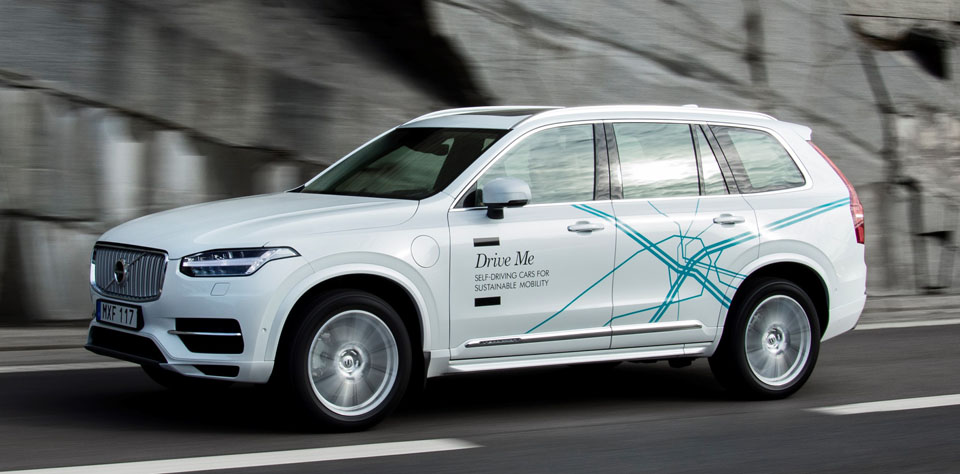
- XC90_Drive_Me_test.jpg
Volvo XC90 Drive Me Project Vehicle

For all models and ages of Volvo cars




Volvo Car UK plans to launch most advanced autonomous driving experiment
29 April 2016
Volvo Cars, the premium car maker, is to begin the UKâs most ambitious autonomous driving trial next year to speed up the introduction of a technology that promises to massively reduce car accidents as well as free up congested roads and save drivers valuable time.
The Swedish company, whose name is synonymous with automotive safety ever since it invented the three point seat belt in 1959, is pioneering the development of autonomous driving systems globally as part of its commitment that no one will be seriously injured or killed in a new Volvo by the year 2020.
âAutonomous driving represents a leap forward in car safety,â said HÃ¥kan Samuelsson, president and chief executive. âThe sooner AD cars are on the roads, the sooner lives will start being saved.â
Mr Samuelsson will make his comments at a seminar sponsored by Volvo and Thatcham, the insurance industryâs research organisation, in London on May 3 entitled âA Future with Autonomous Driving Cars â Implications for the Insurance Industryâ at the America Conference Centre in London.
Volvoâs UK-based test will be called âDrive Me Londonâ and will differentiate itself from other AD programmes by using real families driving AD cars on public roads.
Volvo will source its data from these everyday users and use this data to develop AD cars that are suitable for real world driving conditions, rather than the more unrealistic conditions found on test tracks. Thatcham Research will be providing the technical data analysis and any professional test drivers needed as part of the trial.
Drive Me London will begin in early 2017 with a limited number of semi-autonomous driving cars and expand in 2018 to include up to 100 AD cars, making it the largest and most extensive AD testing programme on Britainâs streets.
The introduction of AD cars promises to revolutionise Britainâs roads in four main areas â safety, congestion, pollution and time saving.
Independent research has revealed that AD has the potential to reduce the number of car accidents very significantly, in some cases by up to 30 per cent. Up to 90 per cent of all accidents are presently caused by driver error or distraction, something that should largely disappear with AD cars.
âVehicle manufacturers are predicting that highly autonomous vehicles, capable of allowing the driver to drop âout of the loopâ for certain sections of their journey, will be available from around 2021. Without doubt, crash frequency will also dramatically reduce. Weâve already seen this with the adoption of Autonomous Emergency Braking (AEB) on many new cars. Research in the US by NHTSA predicts that by 2035, as a result of autonomous and connected cars, crashes will be reduced by 80%. Additionally, if a crash unfortunately canât be avoided, then the impact speed will also drop as a result of the systemâs performance - reducing the severity of the crash,â said Peter Shaw, chief executive at Thatcham Research.
âDriverless cars will see our journeys become faster, cleaner and safer. The UK is leading the way in developing the technology needed to make this a reality thanks to our world-class research base and these types of trials will become increasingly common," Sajid Javid, UK Secretary of State for Business, Innovation and Skills said. âSuch advances in technology prove the fourth industrial revolution is just around the corner and our determination to be at the forefront is why we are attracting top names from across the globe for real-world testing.â
In terms of congestion, AD cars allow traffic to move more smoothly, reducing traffic jams and by extension cutting dangerous emissions and associated pollution. Lastly, reduced congestion saves drivers valuable time.
âThere are multiple benefits to AD cars,â said Mr Samuelsson. âThat is why governments globally need to put in place the legislation and infrastructure to allow AD cars onto the streets as soon as possible. The car industry cannot do it all by itself. We need governmental help.â
Legal | Privacy | Contact Us | Search | Site Map
Volvo Owners' Club Limited® 1962-2026